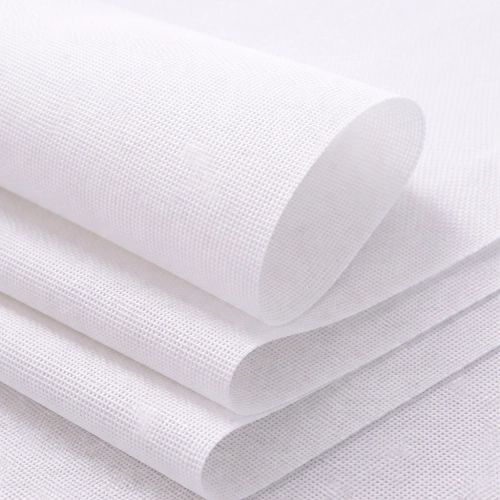
Woven interlining fabric is a critical but often unseen component in garment and textile construction. Positioned between the shell fabric and the lining or facing, woven interlining provides structure, stability, and functional enhancement without altering the outward appearance of the product. Its use spans tailored apparel, uniforms, industrial textiles, and certain home furnishings.
Woven interlining is a support fabric produced using traditional weaving techniques (plain, twill, or satin weaves). Unlike nonwoven or knitted interlinings, woven interlinings exhibit defined warp and weft yarns, giving them predictable mechanical behavior and superior dimensional stability.
Key Characteristics
- High structural integrity
- Controlled stretch (usually minimal)
- Excellent shape retention
- Compatibility with tailored garments
Woven interlining may be fusible (coated with thermoplastic adhesive) or sew-in, depending on the application and performance requirements.
2. Raw Materials and Yarn Selection
2.1 Fiber Types
Common fibers used in woven interlining include:
- Cotton – Breathable, natural hand feel, good heat resistance
- Polyester – Dimensional stability, wrinkle resistance, durability
- Viscose/Rayon – Softness and drape
- Blended fibers – Balance of strength, comfort, and cost
Fiber choice directly influences shrinkage behavior, thermal stability, and compatibility with outer fabrics.
2.2 Yarn Construction
- Ring-spun yarns provide smoother surfaces and flexibility
- Filament yarns offer higher tensile strength and uniformity
- Yarn count (tex/denier) determines stiffness and fabric weight
3. Weave Structures and Their Technical Impact
3.1 Plain Weave
- Maximum stability
- Minimal stretch
- Ideal for shirt plackets, collars, and cuffs
3.2 Twill Weave
- Better drape
- Increased flexibility
- Used in jackets, waistbands, and tailored fronts
3.3 Satin Weave
- Smooth surface
- Enhanced flexibility
- Suitable for luxury garments requiring subtle support
Weave selection affects bending rigidity, shear behavior, and fabric hand, all critical for garment aesthetics and performance.
4. Fusible vs. Sew-In Woven Interlining
4.1 Fusible Woven Interlining
Fusible interlinings are coated with thermoplastic resin (e.g., polyethylene, polyamide, or polyester).
Technical Considerations:
- Fusing temperature range (°C)
- Pressure and dwell time
- Adhesive dot density and distribution
- Compatibility with shell fabric finishes
Advantages:
- Faster production
- Uniform bonding
- Consistent quality in mass manufacturing
4.2 Sew-In Woven Interlining
Sew-in interlinings are mechanically attached via stitching.
Advantages:
- Superior durability for dry cleaning
- No risk of adhesive strike-through
- Preferred for bespoke tailoring and high-end garments
5. Performance Properties and Testing
5.1 Dimensional Stability
- Warp and weft shrinkage under washing or dry cleaning
- Heat resistance during pressing and fusing
5.2 Mechanical Properties
- Tensile strength
- Tear resistance
- Bending and shear stiffness
5.3 Comfort-Related Properties
- Air permeability
- Moisture vapor transmission
- Thermal behavior
Testing standards often follow ISO, ASTM, or AATCC protocols to ensure repeatability and quality control.
6. Garment Applications
6.1 Apparel
- Shirt collars and cuffs
- Jacket fronts and lapels
- Waistbands and pocket flaps
- Uniforms and workwear
6.2 Technical and Industrial Textiles
- Structured textile components
- Reinforcement layers
- Automotive and upholstery sub-structures
Woven interlining is favored where precise shape control and long-term durability are essential.
7. Processing and Manufacturing Considerations
7.1 Cutting and Handling
- Grain alignment is critical due to low stretch
- Bias cutting is sometimes used to improve flexibility
7.2 Fusing Parameters
Improper fusing can lead to:
- Bubbling or delamination
- Strike-through of adhesive
- Fabric discoloration
Controlled fusing conditions and pre-production trials are mandatory.
8. Sustainability and Environmental Factors
- Use of organic cotton or recycled polyester fibers
- Low-melt, solvent-free adhesive systems
- Reduced chemical finishes
Sustainable woven interlining options are increasingly demanded by global apparel brands to meet environmental compliance standards.
Woven interlining fabric plays a foundational role in the structural and functional performance of garments and technical textiles. Its woven construction offers superior stability, predictable mechanical behavior, and long-term shape retention. By carefully selecting fibers, weave structures, adhesive systems, and processing parameters, manufacturers can optimize garment quality, durability, and comfort. As textile engineering continues to evolve, woven interlining remains a vital material where precision, performance, and craftsmanship intersect.